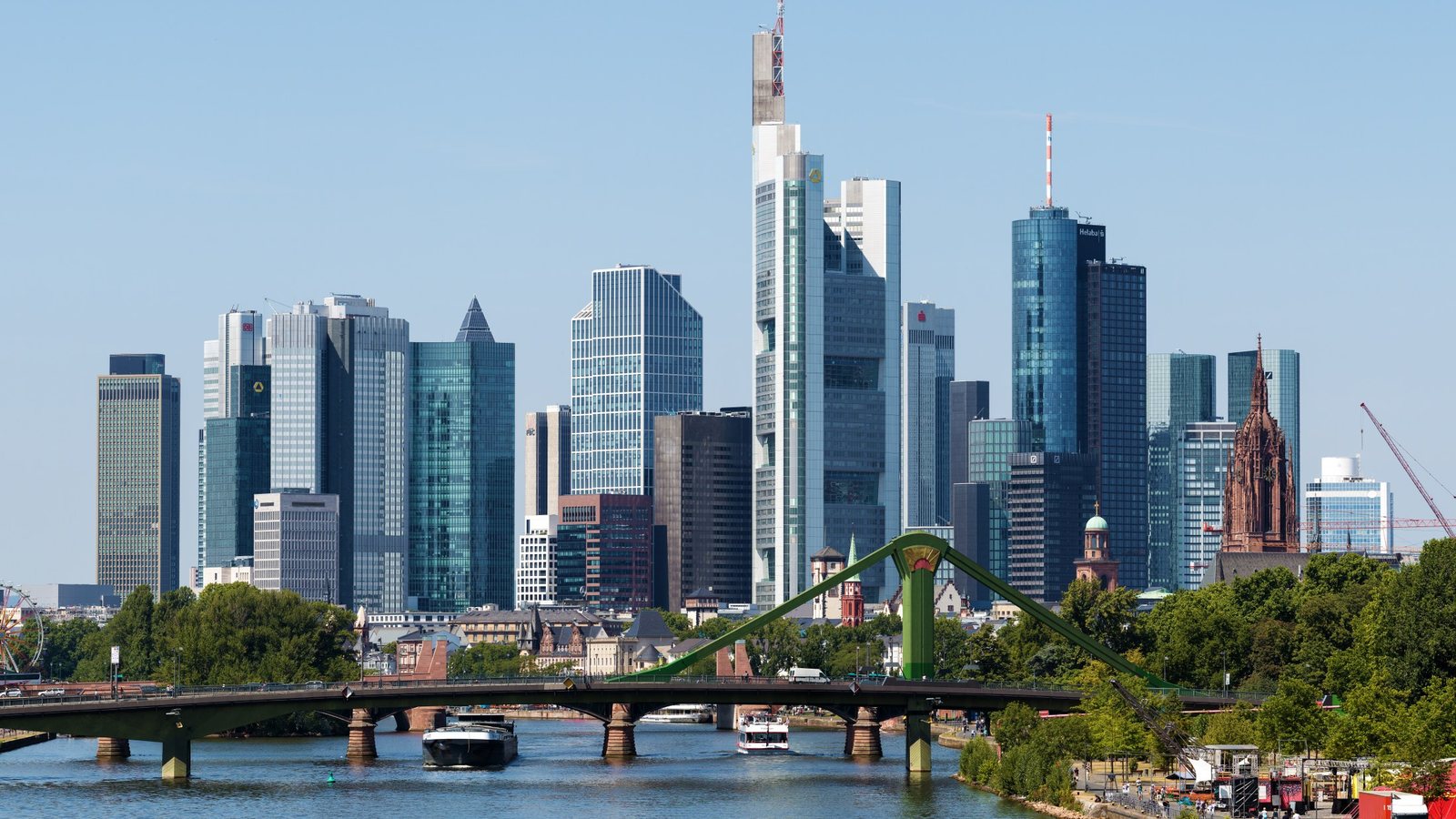
Working in Frankfurt: A Guide for Finance Leaders
Frankfurt is the financial capital of the eurozone. It is home to the European Central Bank, the Bundesbank, Germany’s financial regulator BaFin, the Frankfurt Stock Exchange and, since 2025, the EU’s new Anti-Money Laundering Authority. Since the UK left the European Union, many UK and US banks and asset managers have built or expanded their EU operations in the city, and German subsidiaries of UK groups across every sector look to Frankfurt for finance talent. For a UK finance director or chief financial officer, Frankfurt offers a large, international finance market around an hour and a half’s flight from London, with a governance culture and reporting framework that are distinctively German.
This guide is for UK finance leaders considering a role in Frankfurt, and for UK businesses that need finance leadership for a German operation. It covers where the senior finance roles are, how tax and pay work, what BaFin and German company law expect of a finance leader, how fractional and interim models work, and what German employers look for when they hire from the UK. If you are hiring for a German subsidiary, our contact page is the quickest way to start a conversation.
BaFin supervises banks, insurers and investment firms. The ECB directly supervises the largest eurozone banks.
Progressive income tax, with a solidarity surcharge for higher earners and church tax for church members.
Statutory accounts follow the German Commercial Code (HGB). Listed groups report consolidated accounts under IFRS.
- The Frankfurt finance market
- Where UK finance leaders fit
- Tax, pay and packages
- Regulators, governance and reporting
- Fractional and interim leadership
- Living and working in Frankfurt
- What employers look for
- Questions to ask before you accept
- Frequently asked questions
The Frankfurt finance market
Senior finance roles in Frankfurt fall into four broad groups. The first is banking. Deutsche Bank and Commerzbank have their headquarters in the city, alongside the German operations of most major international banks. After Brexit, a number of UK and US banks moved their EU banking licences and trading entities to Frankfurt, creating demand for finance leaders who can run regulatory reporting, capital management and product control for an EU entity that sits within a global group.
The second group is asset management and insurance. Frankfurt and the wider Rhine-Main region host a large fund management industry, including many of Germany’s investment companies, and the European Insurance and Occupational Pensions Authority is based in the city. These businesses need finance leaders who understand fund accounting, investor reporting and Solvency II.
The third group is the European institutions themselves and the infrastructure around them. The European Central Bank supervises the largest banks in the eurozone directly through the Single Supervisory Mechanism, and the new Anti-Money Laundering Authority, which began operating in 2025, will start directly supervising selected high-risk financial firms from 2028. Deutsche Börse, which runs the Frankfurt Stock Exchange and Clearstream, is another major employer.
The fourth group is the corporate market. Germany’s economy is built on its Mittelstand, the thousands of medium-sized, often family-owned manufacturers and service businesses that are world leaders in their niches, and on large listed groups. Many UK companies own German subsidiaries, and Frankfurt is a natural base for a finance leader overseeing German or wider DACH operations.
Where UK finance leaders fit
UK finance leaders are most competitive in Frankfurt in three types of role. The first is the finance function of the EU entity of a UK or US financial group, where English is the working language, group reporting is under IFRS and experience of UK prudential regulation translates directly. The second is finance director of the German subsidiary of a UK group, where the ability to work with a UK board and consolidate into group accounts is exactly what is needed, supported by local tax and payroll advisers. The third is a CFO role in an international business that operates in English and is preparing for growth, investment or a sale.
Roles in German-owned businesses are a different matter. In most of the Mittelstand, and in many listed German groups, the working language is German, statutory reporting is under the German Commercial Code and the finance director deals daily with German tax advisers, auditors and works councils. Fluent German is usually essential in those roles, and employers will want evidence of experience with German accounting and tax.
Tax, pay and packages
Germany taxes employment income at progressive rates. For 2025, income above a basic allowance of just over €12,000 is taxed at rates rising from 14 per cent to 42 per cent, with the 42 per cent rate reached at around €68,000 of taxable income for a single person. A top rate of 45 per cent applies above roughly €278,000. The thresholds are adjusted each year, and married couples can be taxed jointly, which can reduce the overall bill. A solidarity surcharge of 5.5 per cent of the income tax applies to higher earners, and members of a registered church pay church tax of 8 or 9 per cent of their income tax, depending on the federal state.
Social security contributions for pension, health, unemployment and long-term care insurance are shared between employer and employee and are capped at annual earnings ceilings. Many senior employees choose private health insurance once their salary passes the relevant threshold. The Federal Ministry of Finance publishes current information in English.
German packages for finance leaders usually include a base salary, an annual bonus, a company car or car allowance and a company pension scheme. Some employers pay the salary in thirteen instalments rather than twelve, so check how a figure has been quoted. Paid holiday is generous by UK standards: the legal minimum is 20 days on a five-day week, and 25 to 30 days is common for senior staff. Notice periods are long, often three to six months for senior roles, and contracts for managing directors of a GmbH work differently from ordinary employment contracts, so they are worth reviewing carefully.
Before you accept, take advice on your UK tax position. The United Kingdom and Germany have a double taxation agreement, and HMRC guidance explains how residence and the split-year rules apply when you leave the UK part way through a tax year.
Regulators, governance and reporting
For finance leaders in regulated firms, the main supervisor is BaFin, the Federal Financial Supervisory Authority, which has offices in Bonn and Frankfurt and works alongside the Bundesbank. Members of the management board of a bank, insurer or investment firm must be assessed by the supervisor as fit and proper before they take up their role, and for the largest banks that assessment is carried out with the ECB. Anyone who has been through the FCA’s approval process for a senior manager function will recognise the principle, although the documentation and timelines differ.
German corporate governance has some important differences from the UK. A German stock corporation (AG) has two boards: a management board (Vorstand), which runs the company and usually includes the CFO, and a supervisory board (Aufsichtsrat), which appoints and oversees the management board. Larger companies are subject to co-determination, so employee representatives make up one third of the supervisory board in companies with more than 500 employees and half in companies with more than 2,000. Most subsidiaries are run as a GmbH, managed by one or more managing directors (Geschäftsführer), who carry personal legal responsibilities.
Statutory accounts are prepared under the German Commercial Code (HGB), which is more conservative and more closely linked to tax than IFRS, while listed groups report their consolidated accounts under IFRS. A finance leader in a German subsidiary of a UK group will often maintain both. Germany is also introducing mandatory electronic invoicing between businesses: all businesses must be able to receive e-invoices from January 2025, and the obligation to issue them is being phased in from 2027 and 2028. That is a significant systems and process project for many finance teams.
Fractional and interim leadership
Germany has a well-developed interim management market, and German boards are used to bringing in experienced interim managers for restructurings, carve-outs and system changes. For UK businesses with a German subsidiary, fractional finance leadership is also an option. Around 70 per cent of the work we do across FD Capital Group is fractional: experienced finance leaders who work for a business for a set number of days a month, often for several years.
A typical arrangement is a UK-based fractional finance director who oversees the German entity alongside the UK group, working with a local tax adviser (Steuerberater), a payroll provider and the statutory auditor. Frankfurt is an hour ahead of London and an easy day trip, so regular visits are practical. As the German business grows, the role can step up to a German-speaking finance manager or finance director based locally, often recruited with the fractional FD’s help. Our pages on fractional CFOs and interim CFOs explain how each model works.
Living and working in Frankfurt
Frankfurt is a compact, international city with one of Europe’s largest airports, which makes it easy to travel to London, the rest of Europe and beyond. The financial district around the Bankenviertel is within walking or cycling distance of popular residential areas such as Westend, Nordend and Sachsenhausen, and many families choose the towns of the Taunus hills, such as Bad Homburg, Königstein and Kronberg, for space and schools.
Housing is expensive by German standards but generally cheaper than central London. The region has several well-established international schools, and German public schools are free. Healthcare is through statutory or private health insurance, and the standard of care is high.
Working culture is structured and punctual, with clear processes and a strong emphasis on thorough preparation. Decisions in German companies can take longer, because they often involve the supervisory board or the works council, but once made they tend to stick. Outside banking and the international institutions, German language skills make a significant difference, both at work and in daily life.
What employers look for
Employers in Frankfurt hiring a finance leader from the UK usually look for strong technical accounting, including IFRS and, for German entities, at least a working knowledge of HGB. In financial services they want experience of prudential regulation, regulatory reporting and capital management, and an understanding of how ECB and BaFin supervision works. In corporate roles they want a finance leader who can work constructively with the supervisory board, the auditors and, where there is one, the works council.
For UK groups hiring for their own German subsidiary, the priorities are slightly different. They want someone the UK board trusts, who can consolidate into group accounts, manage German tax and compliance through local advisers and keep the subsidiary’s numbers clear and timely. That is often where a UK finance leader, working with a strong local team, is the best choice.
Questions to ask before you accept
- Who will handle the right to work, and has the employer confirmed it will cover the cost with its own advisers?
- Is the salary paid in twelve or thirteen instalments, and what is the package worth after tax, the solidarity surcharge and social security contributions?
- What is the working language of the finance team, the board and the auditors?
- Will you be a member of the management board or a managing director, and what personal liabilities come with that?
- If the business is regulated, will you need BaFin or ECB approval, and who will prepare the application?
- What notice period applies, and what happens to your role if the business is sold or restructured?
- How will your UK pension, share schemes and tax residence be handled?
For the employer’s side of the decision, our article on hiring an expat FD or CFO is a useful companion, and the Knowledge Centre compares Frankfurt with the other centres we cover.
Frequently asked questions
Do I need to speak German to work in finance in Frankfurt?
Not always. English is the working language in many banks, in the EU entities of international groups and in the European institutions. In German-owned companies, and in any role that deals directly with German tax advisers, auditors or a works council, fluent German is usually expected.
Is my UK accounting qualification recognised in Germany?
The ACA, ACCA and CIMA are well understood by international employers in Frankfurt. They do not entitle you to act as a German statutory auditor or tax adviser, which are separately regulated professions, but finance director and CFO roles do not require those titles.
Can a UK-based fractional FD look after our German subsidiary?
Yes. A UK-based fractional finance director can own reporting, cash forecasting, the audit and the relationship with the UK board, working with a local tax adviser and payroll provider. Frankfurt is close enough for regular visits, and the role can be handed to a local finance lead as the business grows.
Related guides
The Knowledge Centre has a guide to each of the international finance centres we cover. If you are comparing Frankfurt with other locations, these are the most relevant.
About the author
Adrian Lawrence FCA
Adrian is the founder of FD Capital Group and a Fellow of the Institute of Chartered Accountants in England and Wales with a practising certificate. A former listed-company finance director, he has spent more than 25 years at C-suite level. Every international search is run by our specialist team, with Adrian overseeing each mandate.
Finance leadership in Frankfurt
Considering a move, or need finance leadership for a German operation?
Talk to us in confidence. We work with UK finance leaders moving into international centres, and with UK businesses that need fractional, interim or permanent finance leadership for their German subsidiaries.